
Why Most Green Tea Supplements Don't Deliver (And What the Science Says About Absorption)
Why Most Green Tea Supplements Don't Deliver (And What the Science Says About Absorption)
TL;DR
Green tea catechins, particularly EGCG, have solid research behind them for metabolism, fat oxidation, antioxidant defence, and cardiovascular health. But the gap between what is on the label and what actually reaches your bloodstream is stark. Most formulas stop at the extract. We did not.
At Predator Nutrition, we believe that reaching your fitness goals requires a combination of hard work and the right tools. Green tea extract (GTE) is one of the most researched botanical ingredients in the industry, but as with all supplements, the difference between a "standard" product and a high-performance formula lies in the details of the science.
What is green tea extract (and why use an extract instead of a brew?)
Green tea extract is a concentrated form of the Camellia sinensis plant. While a cup of brewed tea is refreshing, an extract isolates the most bioactive compounds—specifically polyphenols known as catechins. The most significant of these is Epigallocatechin-3-gallate (EGCG).
What is EGCG?
It stands for Epigallocatechin-3-gallate. It is the "flagship" catechin in green tea and is the primary compound responsible for its metabolic and antioxidant properties.
What does the science say about the benefits?
When using green tea extract, it’s important to understand what the science supports regarding its health and performance benefits. According to this study published in the British Journal of Nutrition (2023), green tea extract may:
- Reduce Body Mass & BMI: Significant reductions in overall weight and Body Mass Index were observed, particularly in individuals who were already overweight or obese.
- Lower Body Fat Percentage (BFP): The study confirmed that green tea extract helps reduce the actual body fat percentage, not just water weight.
- Boost Antioxidant Capacity: It increased Total Antioxidant Capacity (TAC), helping the body better defend itself against cellular damage.
- Improve Metabolic Hormones: It significantly increased Adiponectin, a hormone that improves insulin sensitivity and supports the body's fat-burning efficiency.
The problem with most green tea capsules
Most green tea supplements are built around a label claim, not a performance standard.
They list "green tea extract" and a headline EGCG percentage. Rarely do they disclose the full catechin breakdown. Even fewer address the real issue: absorption.
On paper, many formulas look potent. In practice, much of the active material never reaches systemic circulation. The reasons for that are specific, well-documented, and almost entirely ignored by the category.
That is the difference between a commodity capsule and an engineered formula.
What actually makes green tea effective
Green tea's activity comes from a family of polyphenolic antioxidants called catechins.
The most studied is EGCG (epigallocatechin-3-gallate). It is the primary compound responsible for the metabolic, antioxidant, and fat oxidation effects attributed to green tea in research. But it does not act alone.
A properly specified extract should contain high total polyphenols, high total catechins, a defined breakdown of EGCG, EGC, ECG and EC, and controlled caffeine content. If those numbers are not disclosed, you are guessing at potency, not measuring it.
Caffeine matters too. Low-quality extracts retain high caffeine levels, which can create a perceived stimulant effect that has nothing to do with catechin activity. A near-zero caffeine extract lets the catechins do the work.
What the evidence supports
The research on green tea catechins is substantial and broadly consistent in direction. The strongest areas include fat oxidation and metabolic support, particularly when combined with exercise; antioxidant capacity and free radical scavenging; cardiovascular markers, including blood pressure and LDL oxidation; and cellular defence mechanisms.
Effect sizes depend heavily on baseline metabolic state, dose, and crucially, how well the product is absorbed. The last variable is where most of the performance gap between products lives.
Important note on UK claims: Green tea extract and EGCG currently have no authorised health claims in the UK for weight loss, fat oxidation, or metabolic rate. What is discussed here refers to the current state of scientific research and should not be read as a guarantee of outcome.
The real bottleneck: bioavailability
This is where the green tea story gets genuinely striking.
Catechins face multiple barriers between the capsule and the bloodstream. They are chemically unstable and degrade in the alkaline environment of the small intestine. They are subject to rapid conjugation and breakdown by phase II metabolic enzymes. A significant proportion of what is absorbed is then actively pumped back out of intestinal cells by P-glycoprotein and multidrug resistance-associated protein efflux pumps before it can reach systemic circulation.
The result: studies have shown less than 1% of orally administered EGCG reaching systemic circulation in some measurements (Cai et al., 2018). Peak plasma concentrations in humans following typical doses sit in the sub-micromolar range, substantially below concentrations used in many in vitro studies to demonstrate the effects that built green tea's reputation.
This is not a marginal rounding error. It is the central problem with the category.
High milligram numbers on a label do not fix this. A higher dose of the same poorly absorbed extract gets you more of the same poor absorption. Addressing it properly requires a formulation approach built around the specific failure modes of catechins.
Most formulas stop at the extract. We did not.
Engineering around it: what cyclodextrins actually do
Cyclodextrins are cyclic oligosaccharides derived from starch through an enzymatic process. Their hollow cone structure gives them a hydrophilic exterior and a hydrophobic interior cavity.
That geometry is the point. A poorly soluble or unstable compound can be physically enclosed within the cavity. The resulting complex presents a water-compatible exterior to the gut environment while the active compound is protected inside. The practical effect is improved solubility, better dispersion in the GI tract, protection against oxidative and pH-related degradation, and more consistent behaviour from dose to dose.
Hydroxypropyl-beta-cyclodextrin (HPβCD) is the most extensively characterised pharmaceutical-grade variant. It is used in licensed pharmaceutical products specifically for these properties. Research into cyclodextrin complexation of catechins has shown meaningful improvements in both stability and systemic availability compared to uncomplexed extracts.
Why a true inclusion complex is not the same as blending
This distinction matters, and the supplement industry largely ignores it.
Combining a green tea extract with HPβCD powder and putting both into a capsule is not a true inclusion complex. In blending, the two ingredients remain physically separate. The catechins are not enclosed within the cyclodextrin cavity. The solubility and stability profile of the catechins is essentially unchanged.
A true 1:1 inclusion complex requires the active molecules to be physically hosted within the cyclodextrin cavity through a specific complexation process. The result is a structurally integrated compound with demonstrably different solubility, stability, and dispersion properties to either ingredient alone.
It is more technically demanding and more expensive to produce. It is also the only version that actually delivers on the absorption rationale.
A brand confident in its formulation will tell you explicitly which it is doing.
Piperine: the complementary mechanism
HPβCD addresses the pre-absorption problem. Piperine works downstream.
Piperine from black pepper extract inhibits specific metabolic enzymes including CYP3A4 and reduces P-glycoprotein-mediated efflux. These are precisely the mechanisms responsible for actively clearing catechins from intestinal cells and for their rapid breakdown before reaching systemic circulation.
The two approaches are complementary, not redundant. HPβCD targets dissolution and stability at the gut lumen stage. Piperine targets post-absorption clearance at the intestinal wall and liver stage. Together they address the two primary points of attrition in catechin bioavailability through different mechanisms.
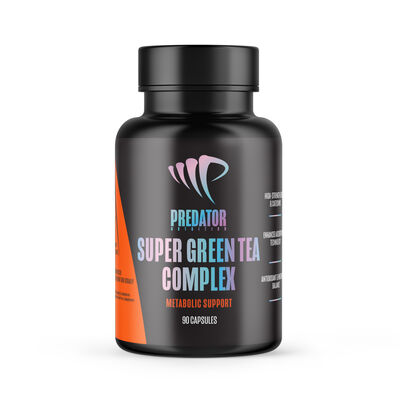 Product Recommendation: Super Green Tea Extract
Super Green Tea Extract is built around a single question: what would it take to make a green tea supplement that actually performs?
The answer starts with a specification most brands do not meet: 98% total polyphenols, 80% total catechins, 50.69% EGCG, with a full catechin breakdown and near-zero caffeine at 0.38%. Every number disclosed. Nothing hidden behind a proprietary blend.
Then the extract is formed into a true 1:1 HPβCD inclusion complex, not blended, to address the solubility and stability failure modes that limit conventional extracts. And 5 mg of 95% piperine is added to address post-absorption clearance through a complementary mechanism.
Per capsule: 250 mg green tea extract within a 500 mg inclusion complex (250 mg HPβCD), delivering approximately 126.7 mg EGCG, 29 mg EGC, 24.5 mg ECG, and 11.5 mg EC, alongside 5 mg piperine.
That level of specification is not typical in this category. It should be.
How to choose a high-quality green tea extract
- Total polyphenol percentage declared. Look for 90% or higher as the primary indicator of extract purity.
- Full catechin profile disclosed. EGCG alone is not the full picture. Look for total catechin percentage of 80% or above with individual catechin figures. Aim for 45-50% EGCG within that broader profile.
- Caffeine content stated. Below 0.5% gives you control over stimulant intake and ensures you are responding to catechin activity rather than caffeine.
- Delivery technology explained with specificity. Does the product address bioavailability and explain how? A true inclusion complex is meaningfully different from blending. If a brand cannot tell you which it is doing, assume it is the latter.
- Piperine inclusion. A complementary post-absorption mechanism that no cyclodextrin approach addresses on its own.
- No proprietary blends. Every active and its dose should be fully visible.
When and how to use it
- Take one capsule daily with food or a light meal. Never on an empty stomach. Concentrated EGCG taken without food significantly increases the risk of nausea and places greater stress on the liver in sensitive individuals.
- Morning or early afternoon is preferable. Even in near-zero caffeine extracts, evening use may interfere with sleep in some individuals.
- Do not exceed 800 mg of EGCG daily from all sources. Do not use on the same day as other concentrated green tea products.
- During focused body composition phases, consistency matters more than timing. Daily use over several weeks produces more meaningful outcomes than sporadic higher dosing.
Side effects, safety, and important warnings
Green tea extract is well tolerated at recommended doses when taken with food. There are a few things worth knowing before use.
Liver health. Concentrated EGCG has been associated with rare cases of hepatotoxicity, typically at high doses taken on an empty stomach. This is considered an idiosyncratic reaction rather than a predictable dose-response effect, but it is real. Always take with food. Stop use immediately and seek medical advice if you notice yellowing of the eyes or skin, dark urine, or abdominal pain.
Pregnancy and breastfeeding. Avoid concentrated green tea extracts during pregnancy and breastfeeding.
Medication interactions. If you are taking prescription medication, particularly for blood pressure, heart conditions, or anticoagulation, consult your GP before use.
Common side effects at recommended doses are mild and largely avoidable: nausea if taken without food, occasional GI discomfort. Both are substantially reduced with correct timing and food co-administration.
FAQs
Why did green tea do nothing for me before?
Almost certainly an absorption problem. Less than 1% of orally administered EGCG reaches systemic circulation in some studies. Without a delivery system engineered to address that, a high-potency label does not guarantee high-potency results.
What is EGCG and why does it matter?
EGCG is the primary active catechin in green tea and the compound most of the metabolic and antioxidant research is attributed to. It is present in meaningful concentrations only in standardised extracts, not in brewed tea.
What is a good EGCG percentage?
Aim for 45-50% EGCG within a broader catechin profile of 80% or above. A standalone EGCG figure with no context on total catechins is insufficient to assess product quality.
Does caffeine content matter?
Yes. Below 0.5% gives you control over stimulant intake and ensures the effect you feel is catechin activity rather than caffeine. High-caffeine extracts can create a perceived effect that has nothing to do with polyphenol performance.
What is a true inclusion complex?
A structural modification in which active molecules are physically hosted within the HPβCD cavity at a molecular level. It is not the same as combining the two ingredients in a capsule. The former changes the solubility and stability profile of the actives. The latter does not.
Why add piperine?
To address post-absorption clearance through a different mechanism to cyclodextrin complexation. The two work on different parts of the bioavailability problem and are complementary rather than redundant.
Is it safe for everyone?
Generally well tolerated in healthy adults at recommended doses with food. Not suitable during pregnancy or breastfeeding. Those with liver conditions, heart conditions, or taking prescription medication should consult a clinician before use.
How does it compare to matcha?
Matcha contains the whole ground tea leaf. A standardised extract isolates and concentrates the catechin fraction specifically, delivering a defined, measurable EGCG dose that cannot be reliably achieved through matcha without excessive caffeine and plant material intake.
Shop Green Tea Extract at Predator Nutrition
As we’ve explored, not all extracts are created equal. To unlock the true potential of Green Tea Extract, you must look beyond the front of the bottle to the specific EGCG standardisation and the delivery methods used.
At Predator Nutrition, prioritise high purity, low caffeine, and enhanced absorption through tools like cyclodextrin complexing to ensure you aren't just buying a supplement—you're buying a tool that works in tandem with your training and nutrition.
Balance your intake with a calorie-controlled diet, maintain consistent timing, and prioritise quality to achieve the best results on your fitness journey.
Ready to Upgrade Your Results? Shop Predator’s Green Tea Extract.
Related
Health Benefits of Ecklonia Cava
Best Supplements To Reduce Cortisol
Important Information & Disclaimer
Food Supplement Policy: This article is provided for informational and educational purposes only and does not constitute medical advice. At Predator Nutrition, we are committed to transparency. Please note that Green Tea Extract and EGCG currently have no authorised health claims in the UK regarding weight loss, fat oxidation, or metabolic rate. Any mention of these topics refers to ongoing scientific research and should not be interpreted as a guarantee of outcome or a claim of the product's efficacy.
Consult Your Doctor: Food supplements should not be used as a substitute for a varied, balanced diet and a healthy lifestyle. If you are taking any prescription medication (particularly for blood pressure or heart conditions) or have a pre-existing medical condition, consult your GP or a qualified medical professional before adding new extracts to your regimen.
References
Cai, Z.Y., Li, X.M., Liang, J.P., Xiang, L.P., Wang, K.R., Shi, Y.L., Yang, R., Shi, M., Ye, J.H., Lu, J.L., Zheng, X.Q. & Liang, Y.R. (2018). Bioavailability of tea catechins and its improvement. Nutrients.
Recommended products