Creatine for women: the supplement you've probably been ignoring
Creatine for women: the supplement you've probably been ignoring
Creatine for women: the supplement you've probably been ignoring
If you're a woman reading this, there's a good chance creatine has never crossed your mind. If you're a bloke, send this to the women in your life who need to see it.
Creatine is the most researched sports supplement on the planet. That's not opinion, it's a fact. Decades of studies, thousands of participants, and the clearest evidence of benefits of any supplement. But somehow, it's still seen as a gym bro thing. In fact, I was recently told a story of a friend of mine’s mum who refused to let her teenage son take creatine because she thought it was steroids.
The irony? Women might actually benefit from creatine more than men do. And the science is starting to show exactly why.
Jump to:
You won't get bulky
This myth won't die, and we want to kill it properly.
Creatine does not make you bulky. It doesn't work like testosterone, it's not a steroid, and it won't turn you into a bodybuilder overnight. Research looking at women across different phases of the menstrual cycle found no significant increase in body mass after creatine supplementation. None.
What creatine actually does is help your muscles produce energy more efficiently. Better performance in the gym, faster recovery between sets, and over time, more lean muscle. Lean muscle is what gives you shape, tone, and strength.
If you've ever picked up a dumbbell and worried creatine would make you wake up looking like a powerlifter, relax. That's not how any of this works.
Strength, performance, and what "toned" actually means
"Toned" is the word people use when they mean muscle without saying muscle. When women say they want to look toned, they're describing having more lean muscle with less body fat. Creatine supports exactly that.
It works by topping up your body's stores of phosphocreatine, which your muscles use to produce ATP, the energy currency your cells run on. When you're lifting, sprinting, or doing anything that requires short bursts of effort, creatine gives you a bit more in the tank. More reps, more power, better recovery.
For women specifically, studies on premenopausal women who train regularly show clear improvements in strength and exercise performance with creatine supplementation. This isn't marginal. If you're putting the work in at the gym, creatine helps you get more out of it. It's not magic, you still need to train, but it makes the training count for more.
Your brain on creatine
Most people think of creatine as a muscle supplement. Fair enough. But your brain is one of the most energy-hungry organs in your body. It accounts for roughly 20% of your daily energy expenditure despite being about 2% of your body weight. It needs ATP just like your muscles do, and creatine plays the same role up there.
Women tend to have lower creatine stores than men, sometimes up to 80% lower. Part of that is down to less muscle mass on average, part of it is dietary (women tend to eat less red meat, which is the main food source of creatine). But women also tend to have lower creatine levels in the brain, particularly in the frontal lobe: the area responsible for mood, cognition and memory.
When your brain doesn't have enough energy to work with, you’ll feel it with brain fog, poor concentration and a low mood.
Research published in 2025 found that creatine supplementation may support brain health in women, including improvements in sleep quality. Sleep connects to everything else: when it suffers, anxiety gets worse, mood drops, and cognitive function follows.
There's also a growing body of evidence linking creatine to reduced symptoms of depression, with some studies showing particular benefits for women. The mechanism seems to involve creatine's role in brain energy metabolism. When brain creatine levels are low, particularly in the prefrontal cortex, it appears to be associated with higher rates of depression and anxiety. Supplementation may help by restoring that energy balance.
We're not saying creatine replaces proper mental health support. If you're struggling, it’s important to speak to a professional. But as part of the bigger picture, the evidence is encouraging, and it's more relevant for women than men because of those lower baseline stores.
Hormones and menopause
Creatine doesn't exist in a vacuum. It interacts with your hormonal environment, and women's hormones shift more dramatically than men's across a lifetime.
During the menstrual cycle, oestrogen and progesterone influence creatine kinase, the enzyme that regulates creatine metabolism. Your body's ability to use creatine isn't constant. It shifts with your cycle. Some researchers think this partly explains why women can feel more fatigued at certain points in their cycle.
But it's during perimenopause and menopause that creatine might become most useful. As oestrogen levels decline, women can experience brain fog, decreased energy, muscle loss, and reduced bone density. Creatine supplementation alongside strength training has shown promise in supporting muscle function and may help improve bone health in postmenopausal women. One study found that a two-year regimen of creatine monohydrate alongside regular exercise was both safe and beneficial for bone at the hip.
How to take it
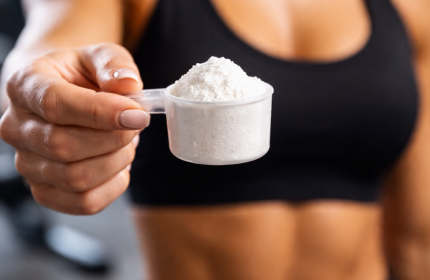
Creatine monohydrate. That's the one. It's the most studied form, it works, and it's the cheapest option. You don't need fancy formulations or anything with a pink label and "for her" on the packaging. Creatine is creatine.
Take 3-5g per day. Every day, with or without food. You don't need a loading phase. That's old school thinking that mostly just gives you stomach issues. Take it consistently and let it build up over a couple of weeks.
Some people notice a slight bump on the scale when they start, typically 1-2lbs. This is intracellular water: water stored inside your muscle cells, not bloating or puffiness. It's a sign it's working.
Mix it in water, coffee, or a smoothie. It's tasteless and dissolves easily. The only thing that matters is that you take it regularly.
Our pick
Our top recommendation is Predator Nutrition Pure Creatine. Straightforward creatine monohydrate, nothing added, nothing unnecessary. We'll be upfront with you though: it's currently out of stock. You can sign up for back-in-stock alerts on the product page so you'll know the moment it's available again.
In the meantime, creatine is creatine. The differences between brands come down to price and preference, not effectiveness. We stock a wide range, so you can find something that works for you right now:
Browse Our Full Creatine Range
So, are you in?
Creatine isn't a men's supplement. It never was. Women stand to benefit just as much, and when it comes to brain health and mood, potentially more. The research has moved well beyond muscle and into territory that matters for how you feel and function day to day.
If you've been on the fence, consider this your nudge. And if someone you know needs to read this, send it their way.
Recommended products